
Weighing Sensor Technologies
Weighing Sensor Technologies
Division size - This is the smallest division size the display will show.
Minimum weight - The minimum weight is the smallest amount a balance can weigh that is accurate - specific to each model of balance or scale.
Capacity - The capoacty is the maximum Gross weight the scale will weigh can read accuratly and dependant on the division size.
Platform size - This is the maximum size that you can weigh goods.
Strain Gauge Sensor ─ Suitable for relatively heavy item and it is durable. ─ Applying load to Strain Gauge affixed metal makes gauge’s resister value change by metal strain. Strain Gauge type sensor measures the change of resister value then converts into weight value. Structure of the sensor is relatively simple so that sensor cost is inexpensive, thus the sensor is suitable for heavy weight measurement. . |  |
Tuning Fork sensor ─No trouble with high accuracy and fast response time. ─ Vibration frequency changes against the application of load to two piece coupled Tuning Fork. Scale measures this frequency change then convert to the weight value. Stress-strain of the Tuning Fork is 1/10th and its output sensitivity is 50 times of Strain Gauge Sensors | 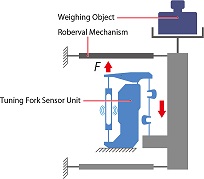 |
| |||
